
How to measure an escalator handrail length
June 30, 2026
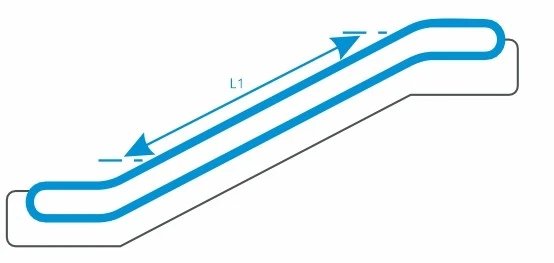
A handrail that is two centimeters short cannot be stretched into place. A handrail that is five centimeters long will not tension, and the splice will creep from the first week. The measurement is the whole job, and it is usually done in a hurry at the end of a service visit.
The handrail is a closed loop, but its length is not the perimeter of the balustrade. It runs over the newel wheels at each end, through the guide system on the incline, and back under the truss, and the curves take up length in a way that a tape measure cannot follow. So you measure the straight sections and add them up.
Start by running the escalator for twenty or thirty minutes. A cold handrail is shorter than a warm one, and the difference on a long outdoor unit is enough to matter. Then stop it with the splice at a convenient place on the incline, lock out the power, and mark the handrail with a paint pen at a fixed reference point, for example the edge of the balustrade panel.
Measure the straight run only. Hold the tape along the top surface of the handrail, mark the end of the straight section before the curve starts, and write the length down as L1. Do not try to follow the curve. Run the escalator forward until the end mark arrives where the start mark was, mark the new position, and measure again as L2. Repeat until the original mark comes back around, then add the partial last segment. The sum of L1 through Ln is the developed length of the handrail.
Two things make this method trustworthy. The marks are made on the handrail itself, so the measurement travels with the belt and no length is lost at the curves. And the run is done under the same tension the handrail will see in service, so the number is not a slack measurement.
The second thing to check is the tension carriage. Most escalators tension the handrail with a spring-loaded carriage at the return end, and the carriage has a working range. If it sits near the minimum when the old handrail is on, the new handrail has to be correspondingly shorter to bring the carriage back into range. If it sits near the maximum, the new one has to be longer. Write the carriage position down before you take the old handrail off, and tell the supplier. This single number prevents most of the "the new handrail will not tension" calls.
On a long unit, measure both sides if the escalator has two handrails and the building has had any structural work. They should be identical, and if they are not, one of them is on the wrong tension setting or the balustrade has moved.
When you order, give the supplier: the total developed length, the handrail profile or section width, the escalator model and rise, the step width, and the tension carriage position. Ask whether the handrail comes endless or with a splice, and if it comes with a splice, whether the splice is mechanical or vulcanized. A vulcanized splice is worth the extra day, especially on a busy unit.
There is one more measurement that gets forgotten: the direction. Handrails are usually symmetrical, but the sliding layer and the cord lay can have a preferred running direction, and a handrail fitted backwards will run and wear differently. Mark the direction of travel on the old handrail before you remove it, and check with the supplier that the new one is not directional.
If the numbers come out strange, measure again rather than rounding. A handrail that measures 2 percent off what the drawing says usually means the mark slipped or the escalator was run in the wrong direction, and it is much cheaper to find that out with a tape in your hand than with a crate on the dock.